Think back to a time when you walked into a room, you didn’t recognize a face in the crowd, you had nowhere to sit, no one to talk to … you felt invisible. Right? Well if you haven’t ever been in that situation-lucky you. For those of you who have-you know it stinks.
You don’t want your wedding guests to feel that way, do you?
Well here is a little secret.
If you don’t have a seating chart … they will.
I can’t tell you how many weddings I’ve attended that didn’t have a seating chart. I realize it is a pain in the neck for most brides. I realize some guests might know a lot of people and want to mingle. I do. I get that.
But imagine your 86-year-old grandmother arriving at the reception and all of the seats near you are taken.
What if there are only individual seats left at each table and nowhere for your favorite cousin and her husband to sit together?
What if your friend who flew 400 miles to be at your wedding walks in and has to ask strangers if they’ll “please” let her sit with them?
That isn’t cool.
Classy brides know they need a seating chart and will bear that cross with a grin ... or at least, a martini.
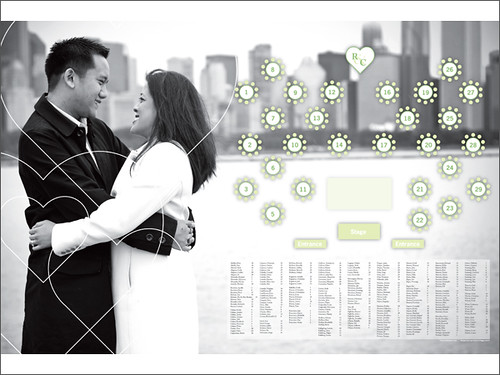
Here are a few tips to help you easily make your wedding reception seating chart.
1. Start Early
I know people won’t RSVP early-or even on time-or even, at all … but there are some people you know will attend. Feel free to call close friends and family members early and confirm they are attending so you can get them on the charts. The same can be done with out-of-town guests.
2. Make an Outline
Well … sort of. Make a graph and pencil in where you will put your VIPs. VIPs include you and your groom, both sets of parents, grandparents, siblings and special relatives, and your wedding party.
3. Let Your Guests Help
Not sure if you should put children at special “children-only” tables or with their parents? Ask them. I knew many of the kids at my wedding would know each other well and would want to sit together. I also realized that my friends’ children might not be comfortable with new people and would prefer to sit with their parents. Ask your guests what they or they children prefer and seat them accordingly.
Along those same lines, assign people you know well to help manage tables. For example, when I got married, my husband’s first cousin from Italy flew to Texas for the event. I knew he would spend several pre-wedding days with other members of the bridal party and I also knew the priest would want to speak Italian with him. I asked some members of my bridal party if they minded sitting with the priest and cousin to make the evening go smoothly for everyone. They agreed and in fact, probably had more fun than any other table.
4. Assign Tables-Not Seats
If the idea is just to have a seat for everyone and to help your guests mingle a little, then assign tables-not seats. This is much easier for you to do.
You don’t have to worry about putting people next to each other and hoping they mesh and you don’t have to make individual place cards. Just create escort cards-a card that includes the person’s name and table number ... and voila! You are done. Visit American Greetings to create your own escort cards or check out Documents and Designs for inspiration.
For even more seating chart tips, read through The Perfect Table Plan site or go to Softlist.Net for free seating chart downloads.
Have you thought about your seating chart? Or even better … have you created it?
Photos courtesy of supermuch and kisokiso
Wednesday, April 1, 2009
Seating Charts for Dummies: How to Create a Wedding Reception Seating Chart


Thursday, August 28, 2008
Wedding Placecard Ideas
Wedding placecards are used to indicate which place setting at a particular table has been reserved for a guest. You can use placecards at any style wedding but they are best for very formal or very intimate weddings, or for weddings that feature long tables where seating might be confusing to your guests.
Although they are a wonderful and thoughtful detail, using placecards requires a lot more effort on the part of the bride and groom who must organize seating tables carefully and far enough in advance to write or print a card for each guest.
Place cards are also referred to as escort cards sometimes. These cards are printed with the guests' names and table numbers on them, telling (or escorting) them to which table they have been assigned. Escort cards can be classic flat cards in envelopes or folded tent cards, usually displayed at the cocktail hour or at the entrance to the wedding reception on a special table.
Whether you call it an escort card when it's sitting on a table waiting to be picked up or a place card, since it's already on the table, there are several unique and interesting things you can do to enhance this little token of your wedding.
One way is to attach a wedding favor to the escort or placecard. This little wedding favor can be a chocolate bar covered in a special personalized wedding wrapper, or a small bag of potpourri. Make sure it blends with your colors and style so you can tie everything together.
Another nice touch is to print the menu on the inside of the placecard. Instead of using the regular-sized place card, use a modified wedding program in its place. On the outside fold of the place card, have the guest's name and table number. On the inside, paste a printed menu along with the wedding couple's names and wedding date. Put this "placecard" on each plate as it corresponds to the escort card's assignment number. It will become a nice keepsake from the wedding.
If your seating configuration is complex or more than likely to change at the last moment, consider using the card in envelope format to double as an escort or place card. This way you can print the envelopes well in advance (go ahead and print one for anyone you think may come - it will make life easier.)
Keep a little stack of numbered cards for each table number and just stuff the envelopes with the cards once your seating is firm. Then if you have last minute changes, you can simply open the envelope, switch the table number (and the place cards on the table) and voila - you are the perfect host anticipating all contingencies.
Thursday, August 14, 2008
Seating The Guests
While it may seem logical to you, many people - especially the ushers - don't have a clue as to how to seat the guests at your wedding. While many guests show themselves to their seats, especially when the usher is nowhere to be seen, there is a custom to escort special guests to their seats before the wedding ceremony begins.
Even though you may be calling these particular groomsmen "ushers," they may not know how to escort the guests to their seats. I knew one usher who blithely took the groom's great-grandmother up the back stairs of the church to the choir loft because he thought it provided the best view in the house. Then he neglected to tell anyone he had done this. For ten minutes, the bride's father, the groom's father and all the bridesmaids were frantically seeking Nana and there she was, all alone in the choir loft trying to figure out how to get downstairs with her walker.
At the wedding rehearsal, take a few moments to explain to the ushers the protocols of seating the wedding guests. You haven't invited all these people to witness your wedding only to have them miffed before the ceremony even starts!
My suggestion is that you have photo prints of each important guest made and placed in a coordinated seating plan. Go over it with the ushers ahead of time. It doesn't cost a lot to have prints made and for you to sketch the rows where these guests are to sit, but it can save huge fusses later.
Place this chart at the back of the ceremony site near the guest book as a reference so that there is no confusion. It's not that you don't trust the ushers to recall your instructions, but they may not know who everyone is and this will help them make things go smoothly.
There are several permutations of seating that occur for different religious wedding ceremonies.
Most prominently, in Christian weddings, the bride's family sits on the left side of the church while the groom's family is on the right. Reform and Conservative Jewish weddings are just the opposite. Orthodox Jewish weddings segregate the men and women from sitting together at all.
The first row of the ceremony site is reserved for parents, the second for siblings, the third for grandparents and other close relatives. After that, ushers may seat guests as they arrive from front to back. Closest relatives should be seated last and separated from the rest of the guests due to their relationship. Guests who arrive late at the wedding ceremony should quietly sit at the back and don't need to be escorted by ushers.
Plan ahead now and save against seating headaches later!